Confirmed Burials (including Ashes)

Search by family name, first name, née name, place, or any date.

The story of the cemetery

Westgarthtown, 16 kilometres north of Melbourne, was first settled by German and Wendish immigrants in March 1850. Soon after, the site for a Lutheran church, school and cemetery was chosen on a centrally located basalt knoll. Over 165 years later, this small private cemetery remains open, although burials are restricted to members of the Thomastown Lutheran congregation and descendants of the original settlers.


The first interment at Westgarthtown, which was also known at times as Keelbundora, Dry Creek, Neu Mecklenburg, Germantown and Thomastown, was of an unknown stillborn child and had taken place by October 1850. Although no burial register for the cemetery survives, headstone or memorial inscriptions, death certificates, undertakers’ records, funeral notices, obituaries and memorial cards confirm over 230 burials. Interestingly, some birth dates on the memorials appear to be incorrect, different from those recorded in old baptism registers in Germany.


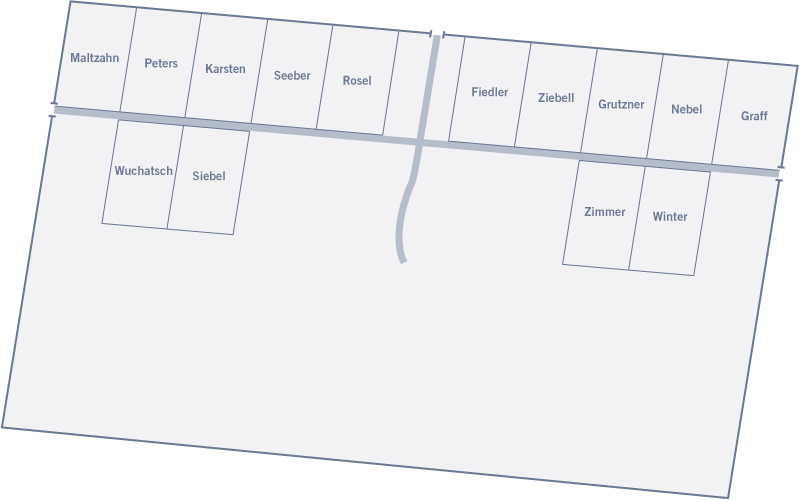
As the original settlers donated the land for the church, school and cemetery, each founding family —Franke, Graff, Groening, Gruenberg, Heyne, Kawerau, Knobloch, Maltzahn, Siebel, Timm, Waehner, Wanke, Winter, Wuchatsch, Ziebell and Zimmer — was allocated a burial plot. A pencil sketch plan, drawn on the inside of the small door in the back of the original altar, shows the location of 14 of the original 16 family plots. These numbered plots, in the northern half of the cemetery, run eastward from the Maltzahn graves in the north-west corner at Gardenia Road and German Lane to the Graff plot in the north-east corner. Separated by the pathway which connects the east and west pedestrian gates, the remaining plots stretch back to the Wuchatsch graves, near the western wall. If a settler sold his farm, the burial plot passed to the new owner.


The graves within the family plots are randomly placed with all headstones facing east. Several are enclosed by iron fences which were common in the nineteenth century. Most graves have marble headstones, although some are of black granite and surprisingly, there is one small bluestone memorial and another of redgum. Many inscriptions are in German with some in both German and English. There are a number of unmarked graves. Some would once have been identified by long-lost wooden memorials, while others were probably never marked.


Burials have also taken place outside the original plots. As well as the first landholding families, other Germans or their descendants from Westgarthtown or nearby Epping and Wollert are also interred here. Some members of the Trinity German Lutheran Church at East Melbourne are buried at Westgarthtown, including Pastor Ewald Steiniger, his wife Annemarie and other family members. Trinity’s German-born Pastor Steiniger, who served the Thomastown Lutheran Church from 1935-64, described the cemetery as ‘An idyllic setting in the Australian landscape.’ Although no longer surrounded by farmlands, it remains idyllic, surviving peacefully within modern Australian suburbia.


The cemetery’s memorials record the passing of those of all ages. Many people, such as Johann and Johanna Graff, Johann and Sophia Maltzahn, George and Dorothea Nebel, Johann Gottlob and Maria Schultz, Johann and Magdalena Wuchatsch, Christian and Sophia Ziebell and Johann and Johanna Zimmer lived long and productive lives before being laid to rest far from their birthplaces in Germany. Johann Gottlob Schultz had been born in 1788. While medical reasons are given for most of these deaths, some are just attributed to ‘old age’.


A considerable number of burials were those of adults whose lives were tragically cut short by illness or accident. Pulmonary consumption or tuberculosis claimed sisters Martha Wuchatsch and Augusta Grützner within six months of each other in 1905/06. John Schuster was killed in 1871 when thrown from a horse on Ziebell’s farm; Henry Grützner drowned on his family’s farm in 1882; and Marie Ewert died in 1894 following a waggon accident at Northcote.


There were also many burials of infants or young children, victims of dysentery, diphtheria and typhoid, or misadventure such as drowning. Six Siebel infants died before they were six months old; three Unmack children before they were more than six months old; and three Graff and three Wuchatsch children before their sixth birthdays.


Maintenance in the cemetery is today undertaken by the City of Whittlesea, but prior to 1993 it was the responsibility of the church trustees, most notably Henry Ziebell, who died in 1988. Another trustee, Norman Young, dug many of the more recent graves, most of which required blasting and back-breaking work to remove solid rock. Many years before his death in 1990, Norman dug his own grave, then refilled it with dirt. Today’s graves are now dug much more quickly and easily with backhoes.


In 2002 replacement timber gates were installed by the City of Whittlesea. Broken or vandalised memorials were also restored with funds provided by descendant families and a grant from the Federal Government. Further repairs were made after an old Monterey pine fell and damaged several memorials during a storm in 2005.

Some pines, planted during the 1870s, have recently been replaced by trees grown with seeds from the old ones. The Italian cypresses, which line the main entrance from German Lane, are also believed to date from the 1870s. As well as native lightwoods and sheoaks, a variety of indigenous and introduced species of flowering plants grow within the cemetery.


The Westgarthtown Lutheran Cemetery, Lutheran Church and reserve are included on the Victorian Heritage Register.