

Schultz family
On 18 May the Yann family of Preston gave Les a farewell party, at which he was presented with a wallet and money belt. He left Melbourne aboard the Wandilla for England on 6 June and disembarked at Plymouth on 26 July 1916. After further training and treatment in November 1916 for venereal disease, he proceeded to France on 31 December and joined the 3rd Pioneer Battalion in January 1917. On 20 March he was detached for special railway construction work, then rejoined his unit on 27 April.
Les served in the field with the 3rd Pioneer Battalion constructing and maintaining defensive positions, roads and similar works until 14 September 1917 when he was admitted to the 11th Australian Field Ambulance with arthritis of the toe. After being transferred between various hospitals and convalescent depots, he was discharged to duty on 2 November 1917. On 24 November 1917, he was attached to the Anzac Section, 3rd Echelon at Rouen and served with that unit until 1 February 1918 when he was promoted to Corporal in the 3rd Echelon, General Headquarters.
On 6 May 1918, he was admitted to the 10th General Hospital at Rouen suffering from scabies. After treatment, he was transferred the following day to the 2nd Convalescent Depot there, then discharged to duty again on 13 May. He was promoted to Temporary Sergeant on 1 September 1918, then transferred to Administrative Headquarters in London on 12 November 1918, the day after the Armistice.
Les was promoted to Sergeant on 17 March 1919 and finally left England to return to Australia aboard the Valencia on 20 July. He arrived back at Melbourne on 11 September 1919. He was discharged from the AIF on 2 November 1919. His name is commemorated at the Preston Cenotaph, however, it was misspelt as Schon and has not been corrected.
Following his return from the war, Les and Eleanor lived at Beauchamp Street, Preston. He returned to his old job as a clerk with the Victorian Railways and they had two children – Betty Jean and Norman Leslie – before Eleanor died in 1930. Les later remarried, to Amelia May (née Barber) Crawford, before his death at Seddon in 1953, aged 65.
Norman Leslie Schou served in the Royal Australian Naval Reserve (PM4650) during the Second World War.
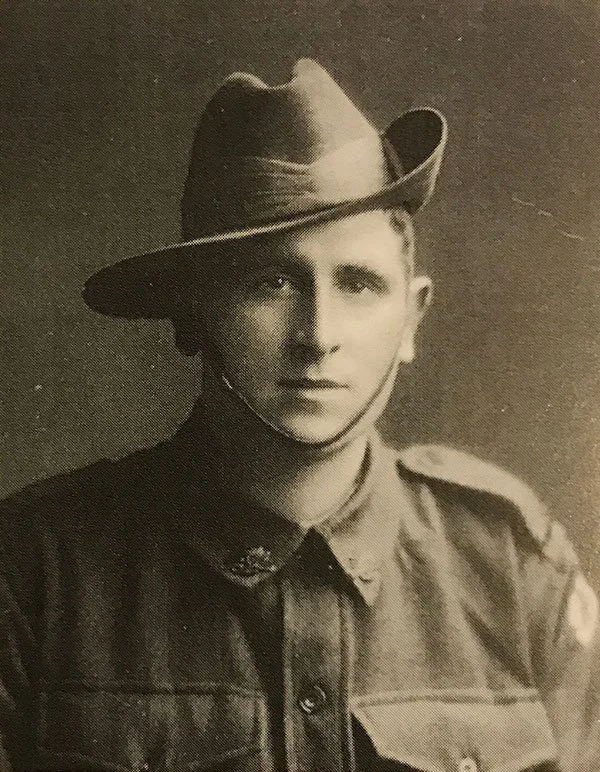
leave from France.Allan Henry Topp (1893-1986) was born on 4 July 1893 at Warragul, the son of John Henry and Fanny Crosby (née Cropley), who married in 1891. Allan’s father, born at Wollert in 1863, was the first of Johann and Maria Topp’s four children. He moved to Ellinbank at South Warragul in about 1881 and after first leasing a farm, purchased his own and remained there until his death from typhoid fever in 1902, aged 39. He was a councillor for the Shire of Warragul at the time of his death. Fanny died in 1950 aged 86.
Allan, the oldest child, is believed to have lived with an uncle after his father’s death. After completing state school, he studied drafting, but deferred this to enlist in the AIF at Melbourne on 1 February 1915. He gave his occupation as ironmoulder, age as 21 and religion as Church of England. He was assigned to D Company, 21st Battalion, Private, No. 985, 6th Infantry Brigade and embarked for Egypt aboard the Ulysses on 8 May 1915.
After further training, Allan left for Gallipoli on 28 August 1915 aboard the Southland, which was torpedoed on 2 September about 40 miles south of Lemnos. Although 32 Australians lost their lives, Allan was rescued by the Neuralia hospital ship and reached Gallipoli on the night of the 7-8 September. His D Company was sent to Courtney’s Post.
On 30 September, the 21st Battalion recorded that “A large percentage of the men are suffering from diarrhea or dysentery…This Bn has been in the trenches 25 days and has sent 4 Officers and 83 others to hospital.’ On 15 November, Allan was admitted to the 12th Casualty Clearing Station at Anzac Cove with bronchitis, then transferred to a hospital ship the following day. He was admitted to hospital at Valetta in Malta on 24 November with severe bronchitis and dysentery and four days later was recorded as being severely ill with enteric fever.
By 11 January 1916 Allan was taken off the serious list and was transferred classified ‘Para Typhoid’ to Egypt and admitted to the 1st Australian General Hospital at Heliopolis on 21 January. He was finally discharged to duty on 6 March after 110 days in hospital. He rejoined the 21st battalion the next day at Moascar but then transferred to the 2nd Pioneer Battalion on 12 March. He left Alexandria for France on 19 March 1916 and arrived at Marseilles a week later.
The 2nd Pioneer Battalion spent the next six months on the Somme, constructing and maintaining roads leading to the front line, building machine gun pits and other works. At Pozieres from 27 July 1916, the 2nd Pioneer Battalion’s work included the construction of trenches, wiring, bomb stores and dugouts for field kitchens.
On 31 August 1916, Allan was promoted to Lance-Corporal. During September he was hospitalized for two weeks at Etaples with influenza, then rejoined his unit. The next few months were spent on tramway construction until he was granted leave to the United Kingdom in December. From 7-22 February 1917 he was hospitalized with frostbite to the toes on his right foot. He was admitted to hospital again in March, then served on the Somme until 7 September 1917 when the 2nd Pioneer Battalion moved to Ypres in Belgium.
Allan was detached on 16 September for two weeks of Anti Aircraft Duty with the 2nd Division Artillery in France. He returned on 2 October and his unit was engaged for the next six weeks in work such as road building, railway track maintenance and placing duckboards in trenches, all under heavy German shelling. He was granted leave to England on 22 January 1918. On 8 February 1918, shortly after returning from leave, he was promoted to Temporary Corporal. On 19 May he was promoted to Corporal, then on 30 May he was posted to the 2nd Pioneer Training Battalion in England, where he attended Lewis Gun training at Tidworth, then attended an Instructors’ course from 28 June to 12 July.
He remained in England. On 25 September 1918 he was found guilty of allowing a prisoner to escape from custody and forfeited 28 days’ pay. Following the Armistice, he was detached from the Training battalion and embarked aboard the Burmah for Australia on 14 December 1918. He arrived back in Melbourne on 29 January 1919 and was discharged from the AIF on 23 March 1919.
After the war, Allan worked in a foundry at Newcastle. On 23 July 1923 he married Margaret Mary (Peg) Jones at Newcastle and they had one child, Patricia. They moved to Sydney in the 1930s and lived for many years at Glebe Point. Peg died in 1950 and Allan moved to Glendale at Newcastle in 1957. Later he lived at Cardiff, then with his daughter in Sydney, before finally moving to a nursing home at Toukley, where he died on 2 June 1986, aged 92.
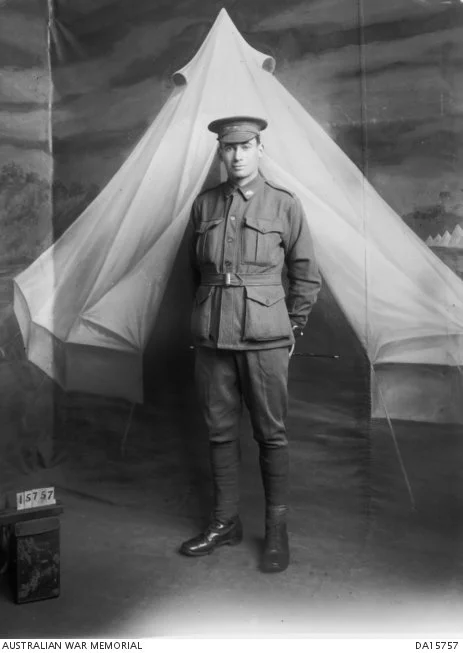
Memorial.Joseph Edwin Olsson (1889-1950) was born at Ellinbank near Warragul on 3 May 1889. He was the fifth child of Auguste and Maria Anna Augusta (née Sandmann) Olsson, who married on 4 September 1875 at the Scandinavian Evangelical Lutheran Church in Melbourne. Auguste, born on the island of Ölan in Sweden, arrived in Australia about 1869 aboard an unknown ship. Anna was Johann Traugott and Maria Dorothea Sandmann’s second child, born at Janefield or Mill Park in 1850.
Auguste and Anna Olsson first leased farms at Wollert, then moved to Ellinbank near Warragul in the late 1880s. In 1889, shortly after Joe’s birth, Auguste selected 171 acres at Neerim East and the family moved there. Auguste died in 1899 aged 56 and Anna in 1926 aged 76 and they were buried at the Neerim Cemetery.
Joe attended school at Neerim East, then worked on the family farm until he enlisted at Warragul on 24 February 1916. He gave his occupation as farmer, religion as Church of England and age as 26. He was initially assigned to the 1/6th Machine Gun Company and served at 20 Depot Battalion, Castlemaine as Private, No. 246 until 9 March, then transferred to Broadmeadows. On 10 April 1916, he was allocated to the 18th Reinforcements, 5th Battalion, Private, No. 5786, 2nd Infantry Brigade. He embarked for England aboard the Ayrshire on 3 July 1916 and marched in to the 2nd Training Battalion at Perham Downs near Salisbury on 15 September.
On 22 September 1916, Joe’s army number was changed again, this time to 5418. A week later he proceeded to France and on 14 October was taken on strength of B Company, 60th Battalion, 15th Infantry Brigade. This battalion was in great need of reinforcements as it had been almost wiped out at Fromelles in July 1916 when it suffered 757 casualties in one day.
In early December Joe was hospitalized for over a week with adenoid laryngitis. He rejoined his unit on 16 December and served with it on the Somme until 11 May 1917, during the Second Battle of Bullecourt, when he was admitted to hospital with trench fever. Five days later he was diagnosed with influenza and transferred to the Reserve Camp at Boulogne, then admitted to the 5th ADBD Hospital at Havre.
Joe finally rejoined the 60th Battalion on 8 June 1917. On 26 September his battalion fought in the successful assault at Polygon Wood near Ypres. On 15 October, he was granted two weeks leave to England, but on 2 November, the day after his return, he was hospitalized with venereal disease. He was discharged to duty on 23 January 1918 but readmitted to hospital on 15 February with an unrecorded illness. He was transferred to various hospitals in France over the next six months before finally rejoining the 60th Battalion on 20 August 1918. On 25 September, the 60th Battalion disbanded, so he was transferred to the 59th Battalion. On 31 October he was granted three weeks leave to England.
On 10 March 1919 Joe was admitted to hospital in France with influenza. After five days he rejoined his unit, then left for England on 23 April. He embarked for Australia aboard the Port Lyttelton on 18 June 1919 and arrived in Melbourne on 5 August 1919. He was discharged from the AIF on 19 September 1919.
On his return home, Joe worked on the family farm at Neerim East with his older brother Albert. On 3 July 1926 he married Violet May Turner of Bena at Ivanhoe. He then worked for the Country Roads Board at Tynong, but returned to the farm at Neerim East shortly before Albert’s death in 1927.
On 6 April 1942, during the Second World War, Joe enlisted in the Citizen Military Forces and served part-time (V367535) with the 11th Battalion, Volunteer Defence Corps, until 26 September 1945 when he was discharged with the rank of Lance-Corporal.
Joe and Violet raised four children before his death on 23 August 1950 aged 61. He was buried at the Neerim Cemetery. Violet died at Dandenong in 1984 and was buried at Springvale Cemetery.
Herman Schleicher
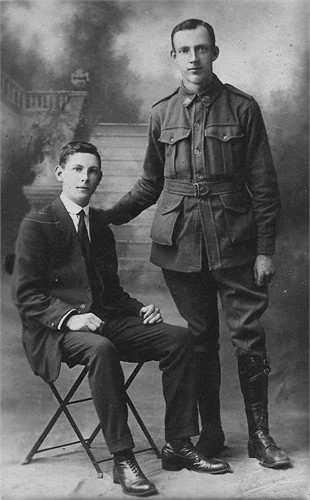
Photo: Anne HurleyHerman Edmund (Snow) Schleicher (1893-1949) was born at Drummoyne in Sydney on 2 September 1893. He was the son of Hermann Edmund and Elizabeth Jane (née Laws) Schleicher, who married in Sydney on 21 February 1895, two years after his birth. In 1898, Hermann and Elizabeth moved to the Western Australian goldfields and settled at Brown Hill, Kalgoorlie where they raised a family of six children. Elizabeth died in 1917 and Herman in 1936.
Snow’s father Hermann was born in South Africa in 1853. In 1855 the Schleicher family moved to Australia and after first living in Victoria, were at Hunters Hill in Sydney by 1861. Hermann’s parents both died in Sydney – Rev. Johann Theophilus Schleicher in 1892 and Caroline Marie (née Schultz) Schleicher in 1897.
Snow married Edith Riseborough at Wagin on 18 November 1915. He applied to enlist at Perth on 30 September 1916 but his service commencement date is 13 November 1916. Aged 24, he was a locomotive fireman with the Western Australian Government Railways. He gave his religion as Methodist. Two of Edith’s brothers had previously enlisted.
He served at various depots until 10 January 1917 when he was assigned to the Railway Corps, Private, No. 958 at Blackboy Hill. On 19 January he was promoted to 2nd Corporal (Fireman). He embarked at Fremantle aboard the Miltiades on 29 January with the 3rd Railway Corps and arrived at Devonport in England on 27 March. After 14 days off duty in April with pleurisy he proceeded to France on 11 May 1917. His unit was later renamed the 5th Australian Broad Gauge Rail Operating Company.
Snow presumably worked as a fireman on locomotives in the field in France. In an undated postcard, written ‘Some where in France’, he wrote to his brother-in-law, Harry Riseborough, a lighthorseman in the Middle East:
‘I received a letter from Edith today and everything is O.K…Well Harry I suppose you have had enough of soldiering by this, it’s not the best of games especially where you are. I won’t forget my first encounter with Iron Rations [enemy fire] a very suitable name. Well we are faring pretty well up to the present but I don’t suppose it will be all milk and honey all the way through. Well never mind we will make up for that when we get back…Snowy’.
From 4-11 September 1917, he was detached to the 268th Railway Company, Royal Engineers. He had leave to England from 19 March - 7 April 1918, then after the Armistice, leave to Paris from 29 November – 9 December 1918. On 13 January 1919 he was detached to the R.O.D. at Calais, then granted leave to England from 27 February – 19 March. He left France on 1 May and embarked in England on 21 June 1919 aboard the Konigen Louise. He arrived home on 2 August and was discharged from the AIF on 10 September 1919.
On his return to Wagin, Snow and Edith raised four children, before his death at Beverley on 17 August 1949, aged 55. Edith died in 1991.